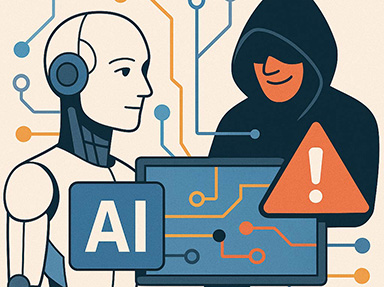

Unlike some of the other scams we talked about in the pages of this website this one is new. AI scamming is something that has been around for the past decade and it has been more and more common in the 2020’s, even though it’s only been around for a short period it has gotten so many people. 77% of Americans said that something that was AI was able to trick them, Being duped by AI is getting more and more common especially with hoe good platform’s are getting at making realistic things. Sometimes it is hard to tell the difference between AI and something real, animal videos are a good example of that. AI also makes us more skeptical if something is real or actually made by a person or a robot, in other words we have trust issues because of robots.
What are AI scams?
AI scams use artificial intelligence tools to target consumers in very sophisticated and personalized ways. Unlike traditional scams, which tend to rely on generic or poorly executed tactics, AI allows criminals to create websites, emails, and impersonations that are startlingly authentic and believable. With AI, scammers can quickly launch fraud campaigns on a massive scale—or zero in on specific individuals using data gathered from social media or other platforms.
How is AI used to scam people?
Voice cloning
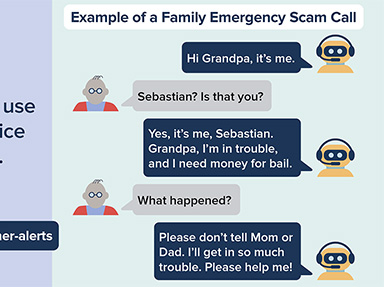
AI can now clone a person’s voice using just a short audio sample, making it possible for scammers to impersonate authority figures and even your loved ones. In one real-life case of an AI voice cloning scam, a Brooklyn woman received a call from what sounded like her in-laws, followed by a stranger claiming the couple was being held for ransom. The voices the woman heard sounded just like her relatives’, but in reality, they had been cloned by AI. Voice cloning is often used in scams where the criminal pretends to be a family member who is in trouble—or a trusted figure asking for urgent help.
Deepfake scams
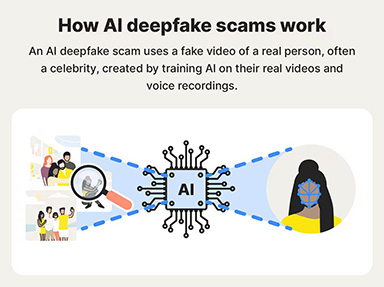
Deepfake technology uses AI to generate convincing videos, photos, and audio clips that make it seem like someone said or did something they didn’t. Scammers use deepfakes to impersonate public figures, celebrities, and even ordinary people in order to promote fraudulent products or persuade consumers to take certain actions. Filmmaker Jordan Peele illustrated the power (and danger) of AI deepfakes in 2018, when he applied his own facial movements to former President Barack Obama’s likeness to create a fake video that went viral. Ironically, in the video, “Obama” warns us about the looming threat of fake news and misinformation.
Phishing email attacks
AI has taken it to a whole new level of deception. An article from Harvard Business Review projects that AI technologies will drive a dramatic increase in the quality and quantity of phishing scams in the years to come. “With AI, scammers can generate very authentic phishing emails that bypass spam filters,” said Lynette Owens, VP of Global Consumer Education & Marketing at Trend Micro. “These emails often look like real account notifications or urgent requests from reputable companies. What’s more, their content is often very personalized. recipient.”
Fake websites
In cryptocurrency scams and other AI scams, criminals send phishing emails or set up online ads promoting high-return investment opportunities or prize giveaways. These ads lead to fake, AI-generated websites that look nearly identical to legitimate ones. When visitors arrive, they’re persuaded to enter their personal information, leading to identity theft or financial fraud. Often, the sites are so realistic, many victims don’t realize they’ve been scammed until it’s too late.